Quick Answer: Stamped concrete driveways in Columbus provide the aesthetic appeal of high-end materials like natural stone or brick pavers at a significantly lower cost. When properly installed with air-entrained concrete and sealed regularly, stamped driveways handle Ohio’s freeze-thaw cycles well and can last 30+ years. Costs are higher than standard concrete but far less than genuine stone or pavers.
Standard gray concrete is functional, but it’s not exactly exciting to look at. If you want your driveway to make a statement—to add genuine curb appeal rather than just provide a place to park—stamped concrete might be exactly what you’re looking for.
We’ve installed stamped driveways across Columbus, Dublin, Powell, and surrounding areas since the early 1990s, and the transformation is always impressive. Homeowners love the upscale appearance without the premium price tag of actual stone or brick pavers.
But stamped concrete isn’t right for every property or every budget. Here’s what you need to know to make an informed decision.
What Is Stamped Concrete?
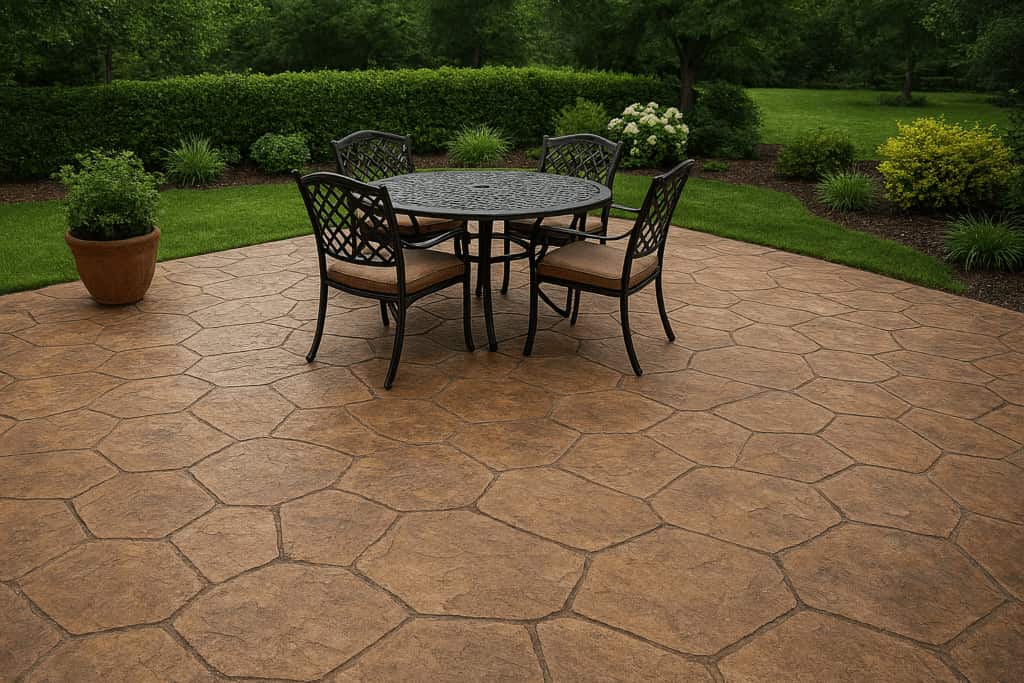
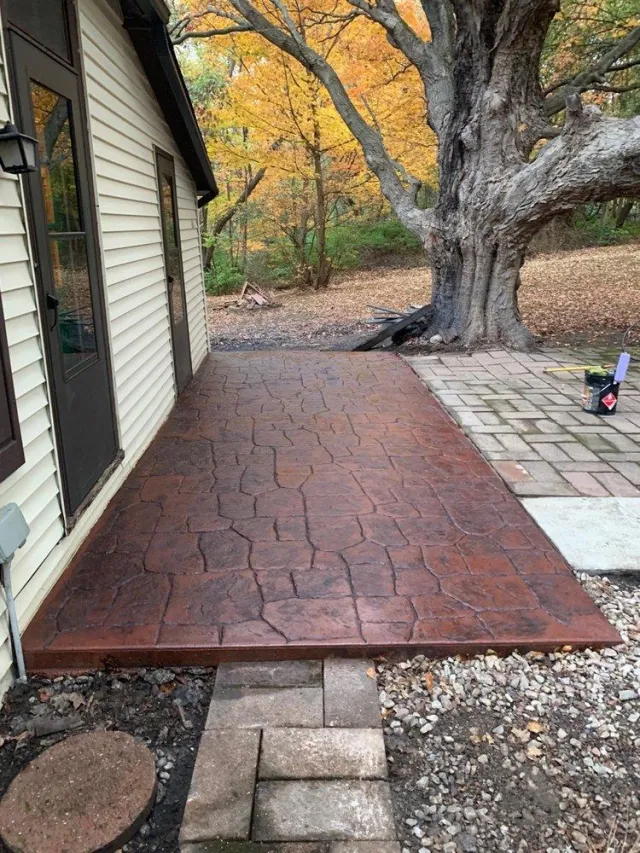
Stamped concrete is a decorative finishing technique where patterns and textures are imprinted into wet concrete before it fully cures. The result mimics the appearance of materials like natural stone, slate, flagstone, brick, cobblestone, wood planks, and tile.
The process involves pouring and smoothing the concrete, applying a color release agent, pressing textured mats or stamps into the surface to create the pattern, and often adding integral color or surface stains for realistic appearance.
Done well, stamped concrete can be surprisingly convincing. We’ve had homeowners in New Albany and Upper Arlington tell us their neighbors thought they’d installed actual stone pavers.
Popular Stamped Concrete Patterns for Driveways
Different patterns create different aesthetics. Here are the ones Columbus homeowners request most often.
Ashlar Slate
This pattern mimics large rectangular stone pieces laid in an irregular pattern. It’s one of the most popular choices because it looks upscale but isn’t overly busy. It works particularly well for driveways because the pattern is large enough to be visible from the street but doesn’t overwhelm the space.
Cobblestone
Cobblestone stamps create the appearance of rounded stones fitted together. It gives a classic, old-world European look. This pattern works best on smaller driveways or as accents because the busy pattern can be visually overwhelming on large surfaces.
Brick
Brick patterns come in several layouts—running bond, herringbone, basketweave. They offer a traditional, timeless look and pair well with brick homes. We see this pattern frequently in established neighborhoods across Worthington and Bexley.
Random Stone
This mimics irregular flagstone or natural stone pieces. It’s excellent for creating an organic, natural appearance and works particularly well for driveways that curve or have non-standard shapes.
Wood Plank
While less common for driveways, wood plank stamping can create a unique rustic or modern appearance depending on the stain colors used. It’s more popular for patios and outdoor living spaces but can work for driveways in the right setting.
Color Options for Stamped Concrete
Pattern is only half the equation. Color brings stamped concrete to life.
Integral Color
This is color mixed throughout the concrete before it’s poured. It provides a base color that won’t wear off over time because it goes all the way through the slab. Common colors include various shades of gray, tan, brown, terracotta, and charcoal.
Color Release Agent
This is a powdered colorant applied to the surface before stamping. It creates color variation and highlighting that makes the pattern look more realistic. When you see stamped concrete that has darker grout lines and lighter stone surfaces, that’s the color release agent at work.
Acid Stains and Surface Stains
Applied after the concrete has cured, these create variegated, natural-looking color with depth and character. They’re often used to add additional color tones or create a more weathered, aged appearance.
The most realistic stamped concrete uses multiple coloring techniques—integral color for the base, release agent for pattern definition, and sometimes additional staining for depth.
Durability in Ohio’s Climate
The big question Columbus homeowners ask: will stamped concrete hold up to our freeze-thaw cycles?
The answer is yes—if it’s done right.
What Makes Stamped Concrete Durable
The concrete itself is the same quality mix we use for any driveway installation. That means air-entrained concrete designed for freeze-thaw resistance, proper 6-inch thickness, wire mesh or rebar reinforcement, and quality base preparation.
The stamped pattern doesn’t weaken the concrete. You’re still getting a solid, properly reinforced slab. The pattern is purely cosmetic—a surface texture that doesn’t compromise structural integrity.
Where Stamped Concrete Can Struggle
The vulnerable point is the surface. Stamped concrete requires sealing to protect both the color and the texture. Without regular sealing (every 2-3 years), the surface can deteriorate faster than plain concrete.
Deicing salts are particularly harsh on stamped concrete. The salts can break down the sealer and cause surface scaling. We recommend calcium-based deicers or sand for winter traction rather than rock salt.
Improper installation is the other risk factor. If the contractor doesn’t get the timing right—stamping too early or too late in the curing process—the pattern can fail or the surface can delaminate. This is skilled work, and inexperienced contractors often make mistakes.
Our 30+ Years of Experience
We’ve been doing decorative concrete work since the 1990s, and we’ve learned exactly how to make stamped driveways last in Central Ohio. Proper concrete mix design, quality base preparation (same as any driveway), correct timing for stamping, professional sealing after curing, and clear maintenance guidance for homeowners.
Carlos personally oversees every stamped project because the execution has to be perfect. There’s no room for error.
Cost Considerations
Stamped concrete costs more than standard concrete but significantly less than the materials it mimics.
Stamped Concrete vs. Standard Concrete
Expect stamped concrete to cost roughly 50-100% more than standard broom-finish concrete. That covers additional materials (color, release agent, sealer), specialized labor and expertise, and the time required for stamping and finishing.
It’s a premium product, but it’s still far more affordable than alternatives.
Stamped Concrete vs. Pavers or Natural Stone
Genuine stone pavers or natural stone can cost 2 to 3 times what stamped concrete costs, sometimes more. Installation is more labor-intensive, and you’ll deal with ongoing maintenance issues like weeds growing between pavers, settling and shifting, and individual pavers cracking or needing replacement.
Stamped concrete gives you the look without those headaches or that price tag.
Long-Term Value
A properly installed and maintained stamped driveway lasts 30+ years—the same lifespan as standard concrete. The sealing requirement adds some ongoing cost (every 2-3 years), but it’s minor compared to the initial savings versus genuine stone.
Stamped concrete also adds curb appeal that can increase property value. We’ve had real estate agents in Westerville and Clintonville tell us that attractive stamped driveways help homes stand out in competitive markets.
Maintenance Requirements
Stamped concrete requires a bit more attention than plain concrete, but it’s still relatively low-maintenance.
Regular Sealing Is Critical
This is the most important maintenance task. Sealing every 2 to 3 years protects the color, enhances the pattern’s appearance, prevents moisture infiltration, and guards against surface deterioration.
Skipping sealing voids most warranties and shortens the driveway’s lifespan significantly.
Cleaning and Stain Prevention
Sweep regularly to remove debris, clean oil or fluid spills promptly (they can stain colored concrete), avoid harsh chemicals or deicing salts, and use gentle cleaners designed for decorative concrete.
Stamped concrete is more prone to showing stains than plain gray concrete, so prompt attention to spills matters.
Winter Care
Use calcium-based deicers or sand rather than rock salt, avoid metal shovels that can scratch the surface (use plastic or rubber-edged shovels), and don’t pile snow on the driveway—spread it out to avoid concentrated freeze-thaw stress.
Design Considerations for Your Property
Not every pattern works for every property. Here’s how to choose wisely.
Match Your Home’s Architecture
Traditional homes pair well with brick or cobblestone patterns. Modern homes often look best with larger, cleaner patterns like ashlar slate. Rustic or craftsman homes can pull off random stone or wood plank patterns.
The goal is visual harmony, not contrast for the sake of contrast.
Consider Driveway Size
Busy patterns (cobblestone, small brick) can overwhelm large driveways. They work better as accents or on smaller driveways. Larger patterns (ashlar slate, random stone) scale better for bigger spaces and are visible from the street.
Think About Color and Surrounding Landscape
Choose colors that complement your home’s exterior and landscaping. Earth tones work well in most settings. Avoid colors that clash with your roof, siding, or trim.
We can show you samples and even digital mockups to help you visualize how different patterns and colors will look on your property. Check out our gallery for real-world examples from Columbus area homes.
Common Mistakes to Avoid
We’ve seen stamped concrete projects go wrong, and it’s usually one of these issues.
Choosing an Inexperienced Contractor
Stamping requires skill and timing. Contractors who don’t do it regularly make mistakes—poor pattern alignment, improper timing that causes surface delamination, color inconsistency, and weak or damaged edges.
Ask to see examples of completed stamped projects and get references from recent clients.
Skipping the Sealer
Some contractors finish the project without sealing, leaving it to the homeowner. Bad idea. The concrete should be sealed shortly after curing for proper protection. If your contractor doesn’t include sealing in the bid, find out why.
Unrealistic Expectations
Stamped concrete mimics stone or brick—it doesn’t replicate it perfectly. Up close, you’ll see it’s concrete. From normal viewing distance (like from your front door or the street), it’s very convincing.
Also, some color variation and minor imperfections are normal and actually make it look more realistic. Expecting absolute uniformity will leave you disappointed.
Is Stamped Concrete Right for Your Driveway?
Here’s how to know if it makes sense for your property.
Stamped Concrete Makes Sense If:
You want upscale appearance without premium pricing, your budget allows for the additional cost over standard concrete, you’re committed to regular sealing maintenance, curb appeal and property value are priorities, and you want a cohesive design that complements your home’s style.
Consider Standard Concrete If:
Budget is the primary concern, you prefer low-maintenance simplicity, your home’s style doesn’t call for decorative elements, or you’re planning to sell soon and don’t want to invest in curb appeal.
Both options can last decades when properly installed. It’s about what fits your priorities and budget.
Our Process for Stamped Driveways
When you work with CR Concrete Construction on a stamped driveway, here’s what to expect.
Carlos meets with you to discuss your vision, shows you pattern and color samples, evaluates your property’s style and landscaping, and provides design recommendations based on 30+ years of experience.
We prepare the site with the same quality base work we do for any driveway installation—proper excavation, compacted gravel, drainage considerations.
The stamping process requires perfect timing and skilled execution. We’ve done this hundreds of times across Central Ohio, and we know exactly how to get it right.
After the concrete cures, we apply a quality sealer and provide you with maintenance guidance so your driveway looks great for decades.
Frequently Asked Questions
How long does the stamping process take?
The stamping itself happens the same day the concrete is poured, typically within a few hours of the pour. The entire project from start to finish usually takes a few days, with 7-10 days of curing before you can drive on it.
Can stamped concrete be repaired if it’s damaged?
Minor surface damage can sometimes be repaired, but matching the pattern and color perfectly is difficult. Significant damage often requires removing and replacing the affected section. This is why proper installation and maintenance are so critical.
Does stamped concrete crack like regular concrete?
Yes, all concrete can crack. Control joints help direct where cracks form, just like standard concrete. The difference is that cracks are more visible on colored, patterned surfaces. Proper base prep and reinforcement minimize cracking risk.
Interested in a stamped concrete driveway for your Columbus home? Contact CR Concrete Construction for a free consultation, or call Carlos at (614) 679-4338 to discuss design options.